Aurora australis forecast tonight
Aurora australis - the southern lights - follows the same rules as the aurora borealis, just centred on the southern magnetic pole. Look south. Stewart Island needs only Kp 3, Tasmania Kp 4 and Ushuaia Kp 6. Peak season is June to August, the austral winter.
How the sky looks right now
Live Kp index from NASA & NOAA, mapped to what it means across Aurora Australis.
Low activity expected. Solar conditions are currently quiet. Chances of aurora visibility are low tonight.
How far the glow reaches
At Kp 1, the auroral oval reaches ~76°S - covering every Aurora Australis town within range.
7-day outlook for Aurora Australis
Tonight shows the live Kp reading. The nights after it show the Kp expected from any coronal mass ejection DONKI predicts will arrive that day, and a quiet baseline of Kp 2 where no arrival is forecast, so tonight's activity does not carry forward. For a longer-range view based on solar rotation, see NOAA's 27-day outlook.
Forecasts beyond 3 days are lower confidence - check back nightly as the outlook firms up.
Aurora visibility by town
Each spot lights up at a different Kp threshold thanks to its latitude. It comes down to the clouds.
Stewart Island
55°SNew Zealand – Rakiura, lowest threshold in the southern hemisphere outside Antarctica.
Invercargill
54°SNew Zealand – southernmost city, Oreti Beach dark sky.
Dunedin
53°SNew Zealand – Otago Peninsula, south-facing dark coast.
Queenstown
53°SNew Zealand – Remarkables dark sky, alpine foreground.
Ushuaia
43°SArgentina – world's southernmost city, Beagle Channel.
El Calafate
39°SArgentina – Perito Moreno Glacier, Lake Argentino.
Tasmania
55°SAustralia – Hobart and Bruny Island, lowest Australian threshold.
Victoria
51°SAustralia – Wilsons Promontory, south-facing mainland dark sky.
Sutherland
32°SSouth Africa – SAAO Karoo site, Bortle 1–2 at 1,798 m.
Cape Town
33°SSouth Africa – Cape Point, south-facing over open ocean.
Best months for Aurora Australis (Stewart Island)
September, March and October average the most aurora nights. This latitude keeps usable darkness in every month, so no month counts zero, but the midwinter figures still sit below the equinox peaks. Stewart Island is the reference here. Further north, in Tasmania or on the New Zealand mainland, the summer nights close up and the figures fall away.
Three ways to do it
Stewart Island
New Zealand's southernmost inhabited island sits at 55°S magnetic latitude, the highest of any inhabited New Zealand position. Kp 3 is enough, reached several times per month during solar maximum. South-facing beaches with almost no light pollution and no mainland light dome make this the most reliably accessible aurora australis destination.
Threshold · Kp 3Ushuaia
The world's southernmost city at 43°S magnetic latitude, on the Beagle Channel with Chilean mountains as a backdrop. Aurora australis has been photographed regularly from the Beagle Channel waterfront and Tierra del Fuego National Park. The austral winter from June to August gives up to 17 hours of darkness.
Threshold · Kp 3Tasmania
Australia's aurora capital at 55°S magnetic latitude - the lowest threshold of any Australian location. Hobart and Bruny Island face south across the Southern Ocean. During G2+ storms, Tasmania sees aurora several times per year. The G5 storm of May 2024 produced vivid displays across the entire island.
Threshold · Kp 5The southern lights explained
Aurora australis is the southern hemisphere twin of the aurora borealis. The same physics drives both: charged particles from the sun follow Earth's magnetic field lines and collide with atmospheric gases near the poles, producing curtains of light. The Kp index - the same 0–9 scale used worldwide - sets the threshold at any given southern latitude, just as it does in Norway or Canada. Look south, not north.
Stewart Island and Invercargill in southern New Zealand are the most accessible locations in the world for aurora australis, needing only Kp 3 - a threshold reached multiple times per month during solar maximum. Ushuaia in Argentina matches that threshold from the Beagle Channel waterfront. Tasmania is the Australian benchmark: Hobart and Bruny Island face south across the Southern Ocean at 55°S magnetic latitude, requiring Kp 5 for reliable displays.
The viewing season is reversed from Europe: June to August brings the longest dark nights in the southern hemisphere. The September equinox adds geomagnetic activity on top of lengthening nights. South Africa, at 32–33°S magnetic latitude, needs G3–G4 storms - rare, but the G5 event of May 2024 produced aurora photographed from Cape Town and the Karoo, showing what extreme space weather can achieve even at low southern latitudes.
Compare Aurora Australis locations tonight
Pre-filled with Aurora Australis's top spots - search 369 countries and towns worldwide to compare any of them side by side.
Up to 8 locations
How often does the aurora appear in Aurora Australis?
Average nights per month the Kp reached Stewart Island's threshold, from 15 years of geomagnetic data (2010–2024).
Based on Kp threshold crossings for Stewart Island (Kp 3) from 2010–2024. Counts nights when sufficient geomagnetic activity occurred - cloud cover not included. March and September lead, matching the equinox peak in geomagnetic activity; the austral winter months sit lower despite their longer nights.
Plan your trip to Aurora Australis
Best window
June, July, and August give the longest dark nights. September adds equinox geomagnetic activity. Stewart Island and Ushuaia have aurora-capable nights throughout the austral winter - the key variable is cloud cover, not darkness.
Which destination?
Stewart Island is easiest - ferry from Bluff or short flight from Invercargill, minimal light pollution, Kp 3 against Invercargill's Kp 4. Ushuaia adds drama: the Beagle Channel and mountains. Tasmania suits those combining Australia travel. South Africa requires a genuine G3+ storm.
Related pages
Aurora Locations Worldwide
Global aurora forecast hub - all northern and southern hemisphere locations.
Read →Aurora Australis New Zealand
New Zealand hub - Stewart Island, Queenstown, Dunedin.
Read →Aurora Australis Australia
Australia hub - Tasmania, Victorian Alps, and the south coast.
Read →Aurora Australis Argentina
Argentina hub - Ushuaia and El Calafate.
Read →Aurora Australis South Africa
South Africa hub - Sutherland and Cape Town, extreme storms needed.
Read →What Is the Kp Index?
How the Kp scale works for both hemispheres.
Read →Aurora photographs from Aurora Australis
Real photos sourced from Wikimedia Commons.
 Amundsen-Scott marsstation ray h edit
  Aurora borealis over Eielson Air Force Base, Alaska
  Aurora borealis above Storfjorden and the Lyngen Alps in moonlight, 2012 March
  Aurora australis ISS 20120715
  Aurora australis dancing over an LED illuminated igloo
  Virmalised 18.03.15 (4)
 Guides for visiting Aurora Australis
In-depth planning resources for your northern lights trip.
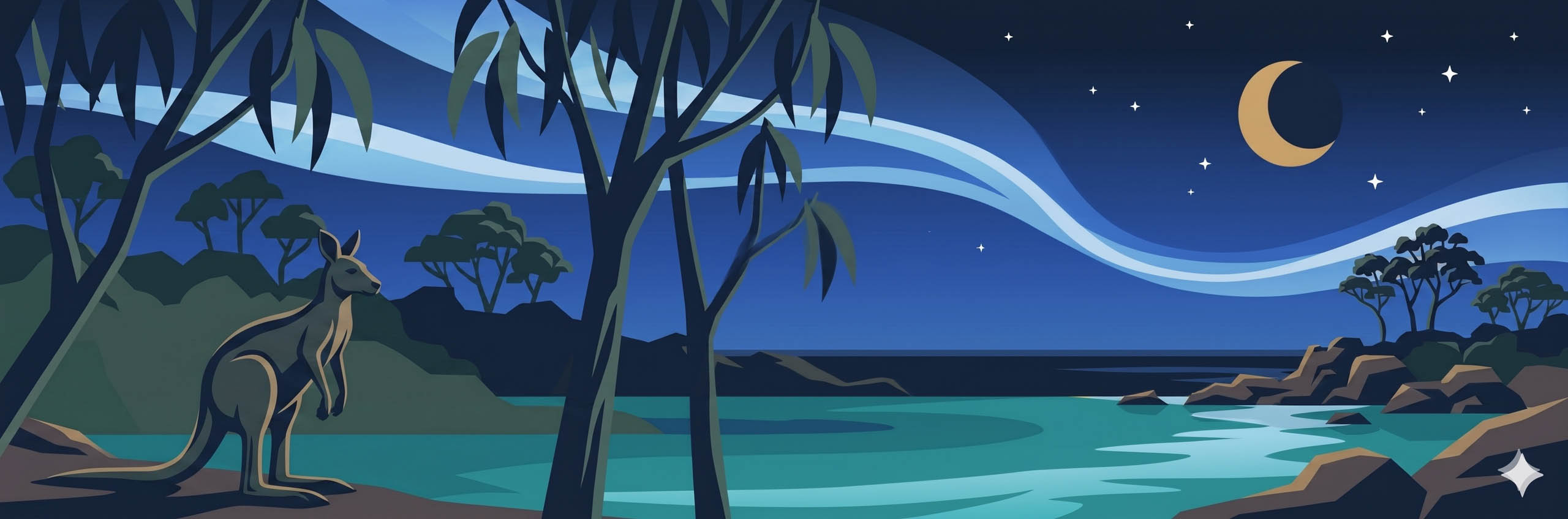 Travel guide Australia
 Aurora Australis in Australia - Where to See It
Tasmania, Victoria, and South Australia - dark sky sites, Kp thresholds, and best months.
 Travel guide New Zealand
 Aurora Australis New Zealand - Complete Guide
Stewart Island, Queenstown, Dunedin - when to go, where to stand, and what Kp to watch for.
 Travel guide Planning
 How to Plan an Aurora Trip
Timing, destination choice, and what to expect - applies equally to aurora australis.
 Science Science
 What Is the Kp Index?
The global geomagnetic activity scale - same index, same rules, for both hemispheres.
 Planning Planning
 Best Time to See Aurora Australis
June to August is peak season in the southern hemisphere - here's why and what to expect month by month.