Northern lights in Å i Lofoten tonight
Moskenes, Lofoten Islands, Northern Norway · 68° magnetic latitude · Kp 2 threshold
Kp 1 is below the threshold for Å i Lofoten. Activity would need to rise to Kp 2 before aurora could reach this latitude.
7-day outlook for Å i Lofoten
Based on CME arrival predictions from NASA DONKI. Arrival times ±6 hours.
auroratonight.space
What Kp is needed here?
Å i Lofoten sits at a magnetic latitude of approximately 68°N. The Kp index - a global measure of geomagnetic activity on a scale from 0 (quiet) to 9 (extreme storm), updated every 3 hours - needs to reach Kp 2 before the auroral oval expands far enough south to be visible from here.
At Kp 2, visibility is possible from Å i Lofoten but skies need to be clear and dark. Cloud cover and light pollution remain the main obstacles even when Kp is high enough.
Best dark sky sites near Å i Lofoten
Light pollution is the biggest obstacle after cloud cover. These sites give you the best dark northern horizon within reach.
Å harbour and village
Get directions ↗One of the smallest villages on the Lofoten island chain, clustered around a working harbour with the preserved buildings of the Norwegian Fishing Village Museum. There's next to no artificial light here beyond the harbour itself - being the very end of the road keeps it that way.
Ågvatnet lakeshore
Get directions ↗A short, flat walk along the lake south of the village opens onto still water that reflects the sky when conditions are calm, with steep peaks framing the view. Easy access without the elevation or exposure of the summit routes nearby.
Munken summit trail
Get directions ↗A demanding hike to a 775 m summit above Sørvågen, giving a panoramic view over the southern tip of Moskenesøya and open sea beyond. A serious undertaking after dark, best reserved for those with hiking experience and proper winter equipment.
Best time to see the northern lights in Å i Lofoten
At 68°N magnetic latitude, Å i Lofoten has one of the longest aurora seasons in the world. Meaningful darkness returns in late August and displays are possible on almost any clear night from September through March. Only the endless daylight of May, June, and July rules out viewing completely.
Activity peaks around the September and March equinoxes, when Earth's magnetic field geometry is most favourable for coupling with the solar wind. Events during these two windows tend to produce the strongest displays of the year for observers at Å i Lofoten's latitude.
May through July is effectively impossible for aurora viewing: the midnight sun keeps the sky bright around the clock at this latitude. No storm level, not even G5, can produce a visible display without astronomical darkness.
Up to 8 locations
This page contains affiliate links to tour operators and products on Amazon. If you book or buy through one of these links, I may earn a small commission at no extra cost to you. This doesn't influence which operators or products are featured, or what the forecast shows.
The end of the road, in a good way
Å sits at the literal southwestern terminus of the E10, Lofoten's spine road - Norwegian for the last letter of the alphabet, and a frequent tagline for the village. It's smaller and quieter than Reine, 10 km back up the road, built around a working harbour and the preserved buildings of the Norwegian Fishing Village Museum rather than a bigger tourism scene. Being the end of the line is exactly what keeps its sky dark: there's nothing further along the road to spill light in.
When to go
The season runs roughly October to April, matching the rest of Lofoten. At 68 degrees magnetic latitude, Kp 2 is a low, regularly achieved threshold - the same band as Reine, Svolvær, and Leknes. As anywhere on this coast, the North Atlantic weather is the bigger variable than the Kp reading; a clear night here is the harder thing to guarantee.
Getting there and getting around
Fly to Leknes (LKN) from Bodø or Oslo; from there it's about 47 km southwest to Å via Reine along the E10, roughly an hour's drive. There's no fuel station between Leknes and Å, so fill up before setting out. A hire car is essential here - this is the end of the road, with no public transport running this far after dark.
Where to watch
The village and harbour themselves are dark enough for most nights, with the preserved fishing-village buildings giving a distinctive foreground. A short, flat walk to Ågvatnet lakeshore opens onto still water that reflects the sky on calm nights. For a serious undertaking, the Munken summit trail climbs to 775 m above nearby Sørvågen - a demanding 4-5 hour round trip best reserved for experienced winter hikers, not a casual evening option.
What to expect, honestly
Å's Kp 2 threshold puts it on equal footing with the rest of Lofoten, and its position at the literal end of the road means the darkness is about as reliable as anywhere on the island chain. The trade-off is that it's genuinely remote even by Lofoten standards - a smaller, quieter stop than Reine, with fewer services and no fuel between here and Leknes. Treat it as a deliberate detour to the end of the E10, not a quick stop on the way to somewhere else.
Related pages
Northern Lights Norway
Norway-wide aurora forecast and location hub.
Read →Northern Lights Reine Tonight
Reine - 10 km up the E10, Reinebringen summit and Kirkefjord.
Read →Northern Lights Leknes Tonight
Leknes - central Lofoten base and airport town.
Read →Northern Lights Henningsvær Tonight
Henningsvær - fishing village harbour further up the chain.
Read →What Is the Kp Index?
Why Kp 2 is enough at 68°N magnetic latitude.
Read →Aurora photographs from Å i Lofoten
Real photos sourced from Wikimedia Commons.
 Aurora over Å i Lofoten
 Aurora over Å i Lofoten
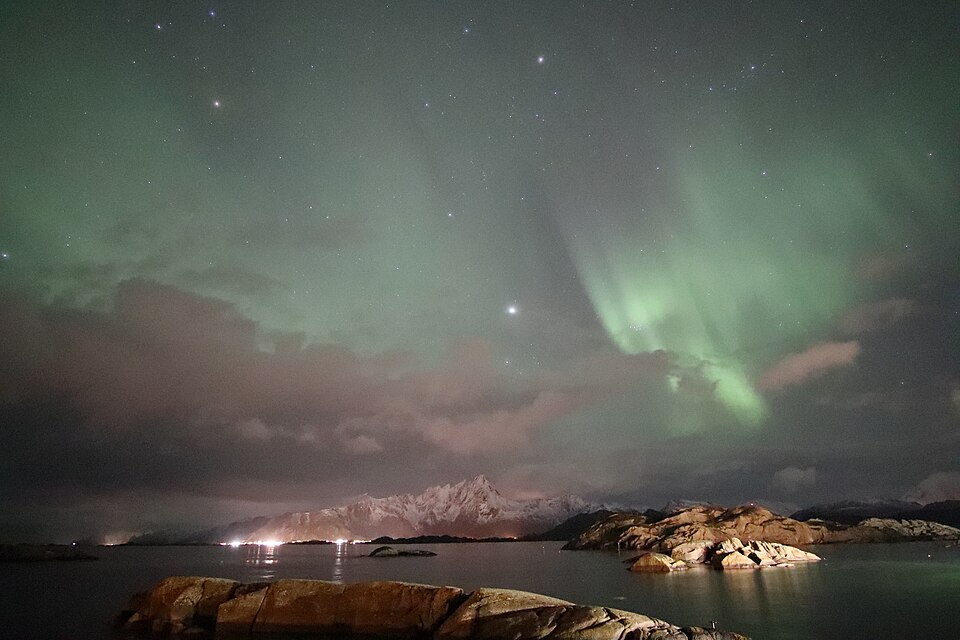 Aurora over Å i Lofoten
Planning your aurora trip
In-depth guides to help you plan a trip to see the northern lights.
 Travel GuideNorway
Norway vs Iceland - Which is Better for Northern Lights?
Real probability by trip length, plus latitude, weather patterns, landscapes, cost, and accessibility compared head to head.
 Travel GuideNorway
Northern Lights Norway - Complete Travel Guide
Tromsø, Lofoten, Svalbard, and the rest - planning a Norway aurora trip from scratch.
 Travel GuideNorway
Lapland Northern Lights Guide - Finland, Sweden, and Norway
Lapland spans three countries, not one - real Kp data comparing Finnish, Swedish, and Norwegian Lapland, plus Sápmi cultural context.